Pest List H-K
| Pest / FS link | Excerpt |
|---|---|
Hackled band weavers (stinging & biting)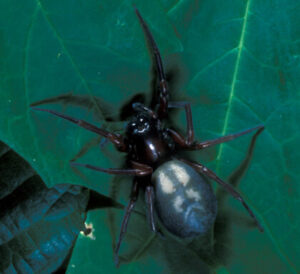 | These are robust spiders commonly found in crawl-spaces in western Washington. Hackled band weavers have grayish abdomens and chestnut colored legs and carapaces (exoskeleton over their head and thorax). A bite from a hackled band weaver results in a temporarily painful sensation much like a yellowjacket sting. |
Head lice (stinging & biting)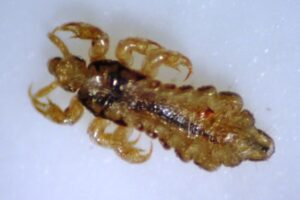 | The human head louse is a common pest, frequently found where large numbers of people are in close daily contact. It can be a significant pest in schools, particularly among preschool and elementary-age children. |
Hobo spider (curiosity & beneficial)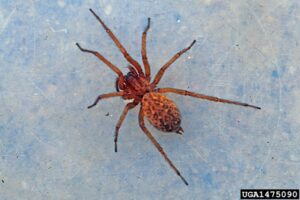 | The hobo spider (Eratigena agrestis, formerly Tegenaria agrestis) is one of the most commonly found funnel-web or funnel weaver spiders in some parts of Washington. This relatively large (1 – 1 3/4 inches including legs), swift-running spider builds its funnel-shaped web in dark, moist areas, often in basements, and waits at the mouth of the funnel for prey to become entangled in the web. |
| Hobo spider (nuisance) | The hobo spider (Eratigena agrestis, formerly Tegenaria agrestis) is one of the most commonly found funnel-web or funnel weaver spiders in some parts of Washington. This relatively large (1 – 1 3/4 inches including legs), swift-running spider builds its funnel-shaped web in dark, moist areas, often in basements, and waits at the mouth of the funnel for prey to become entangled in the web. |
Honey bees (curiosity & beneficial)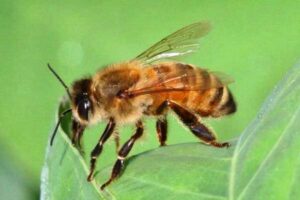 | The domesticated honey bee, Apis melifera, is a crucial pollinator for many agricultural crops including tree fruits and small fruits. In the home garden, honey bees help pollinate and ensure the productivity of our fruit trees, berry patches, and vegetable gardens. The honey bees we most often encounter in the garden are female workers, collecting pollen and nectar. |
House centipede (nuisance)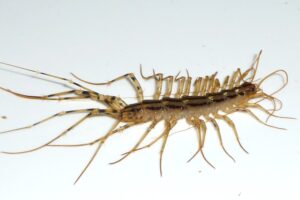 | The house centipede (Scutigera coleoptrata) is a slender, flattened, many-segmented arthropod approximately 1 to 1 1/2 inches long. It can be found throughout the United States, both in and outdoors in warmer areas, and primarily indoors in colder regions. This centipede is grayish-yellow in color with three dark stripes running along its back. |
House dust mites (nuisance)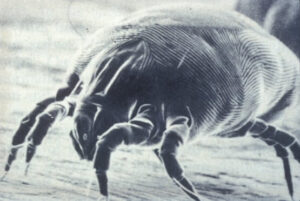 | House dust mites are extremely small (up to 0.5 mm) and can be found as a component of house dust. They are principally found in cotton-stuffed mattresses and furniture, although they can also be found on birds, in bird nests, on animals and on humans. |
House flies (nuisance)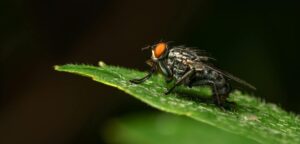 | The house fly is one of the most cosmopolitan insects and has been considered a pest for centuries. The house fly measures 3/16 to 1/4 inch long and can be distinguished from other flies by the 4 dark stripes on the thorax and the yellowish abdomen with dark markings. |
Indian meal moth (food & fabric)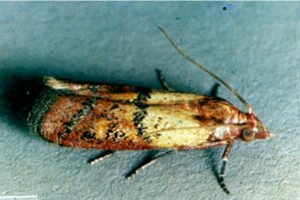 | The most common moth found in foodstuffs is the Indian meal moth. This moth has a wingspan of about 1/2 to 3/4 inch. The tips or outer half of the wings are reddish-brown or “coppery”, while the basal parts are grayish-white. The larvae are usually off-white but can be pink, yellowish, greenish, or brownish. At maturity, the larvae are about 1/2 inch long. |
Jumping spider (curiosity & beneficial)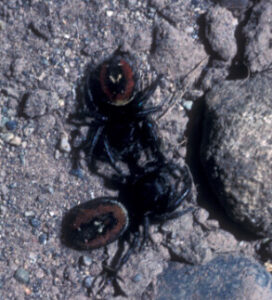 | Jumping spiders are compact, active, and usually colorful spiders that are found on window sills, ceilings, and on outside walls and foundations of homes. These spiders have large eyes, and use their good eyesight to catch prey. |
| Jumping spiders (stinging & biting) | Jumping spiders are compact, active, and usually colorful spiders that are found on window sills, ceilings, and on outside walls and foundations of homes. These spiders have large eyes, and use their good eyesight to catch prey. |
Pest List Menu

WSU Extension programs and employment are available to all without discrimination. Evidence of noncompliance may be reported through your local Extension office.