Pest List D-G
| Pest / FS link | Excerpt |
|---|---|
Deathwatch beetles [Anobiids] (wood destroying)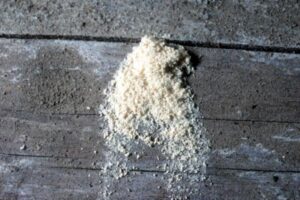 | Deathwatch beetles or anobiids are reddish to chocolate brown beetles ranging from 1/8 to 1/4 inch long. These beetles are rarely seen by people, but fresh piles of granular or gritty frass (insect excrement) on the outside of joists, mudsills, etc. are a sign of their presence. The larval form spends 4-5 years feeding on wood before emerging, mating and laying eggs. |
Drugstore beetle (food & fabric)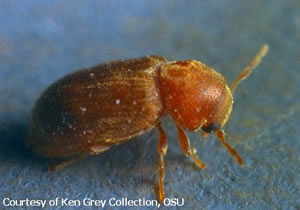 | Adult drugstore beetles are reddish-brown beetles about 1/8 inch long. Their head is bent downward, making it difficult to see their head when viewed from above. How long a drugstore beetle lives depends on its food source and environmental conditions. The larvae are C-shaped creamy white grubs and can feed for two to twenty months. |
European fire ant (stinging & biting)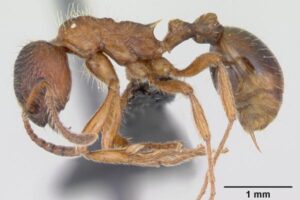 | The European fire ant (Myrmica rubra), sometimes known as the red ant or ruby ant, is a native of Europe and Asia. It has been present in the northeastern United States and neighboring Canadian provinces for many years, and has also been found recently in Washington State and British Columbia. While its occurrence in the Pacific Northwest is relatively isolated for now, it has great potential to spread and become a significant pest in our area. |
European paper wasp (stinging & biting)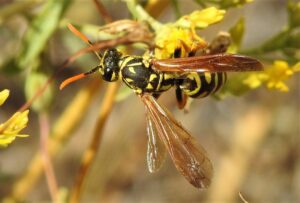 | The European paper wasp was introduced into Washington in the late 1990’s. Although we have a native paper wasp, it is found mostly in eastern and central Washington. The European paper wasp is now the most common species in western Washington. Like yellowjackets, they are about 1/2 inch long as workers and are black- and yellow-striped. However, paper wasp have a more thread-like waist than yellowjackets. |
Firebrats (nuisance)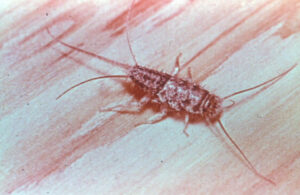 | Firebrats are wingless, fast-moving insects about 1/2 inch long. They have two long antennae on their head and three long bristles on their tail. Firebrats are mottled tan in color and prefer to live in very warm areas such as around furnaces and hot water pipes. They feed on starchy materials such as glue, paste, fabric finish, book bindings, paper and fabric and can be found anywhere in the house. |
Fleas (stinging & biting)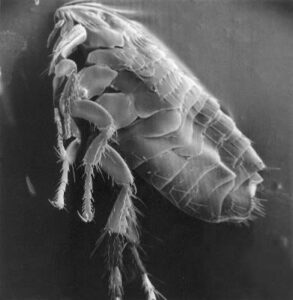 | Fleas are “nest parasites”. They generally move between the host animal (cat or dog) and the bedding (nest). The typical flea population in a home is comprised of 50% eggs, 35% larvae, 10% pupae, and only 5% adult fleas. Eggs, larvae and pupae are typically found in pet bedding, carpets, rugs, or on upholstered furniture where pets sleep. |
Fruit flies (nuisance)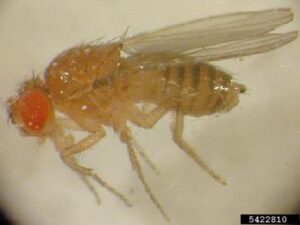 | Fruit flies are a common and annoying problem in homes, restaurants, supermarkets, and any other place where there is rotting and fermenting food. Fruit flies can be a problem any time of the year. Adult fruit flies are 1/8 inch long, usually have red eyes, and a tan and gray body. Fruit flies lay their eggs near the surface of fermenting food and moist organic material. |
Fungus gnats (houseplants)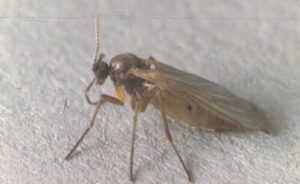 | Fungus gnats are small (1/8 inch) gray-black flies often noticed around houseplants and windows. Most species inhabit fungi or dead plant material, but a few species have maggots that injure plant roots. Even non-pest species can injure plants if their preferred food source of decaying plant material is not available. |
| Fungus gnats (nuisance) | Fungus gnats are tiny, dark, slender flies about 1/8” long which commonly infest the soil and roots of houseplants. Adult fungus gnats are mainly a nuisance, flying around plants and running on the soil and other nearby surfaces. The larvae of some species attack roots. With sufficient numbers of larvae present, larval damage may cause yellowing and wilting of leaves. |
Giant house spider (curiosity & beneficial)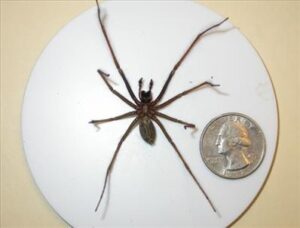 | The giant house spider, Eratigena atrica (formally known as Tegenaria gigantea and T. duellica), is commonly found in and around Washington homes west of the Cascade Mountains. Its range also includes parts of coastal Canada and Oregon. They are not found east of the Cascades in Washington. It is often seen in mid-summer to early fall, when males in particular are highly mobile. |
| Giant house spider (nuisance) | The giant house spider, Eratigena atrica (formally known as Tegenaria gigantea and T. duellica), is commonly found in and around Washington homes west of the Cascade Mountains. Its range also includes parts of coastal Canada and Oregon. They are not found east of the Cascades in Washington. It is often seen in mid-summer to early fall, when males in particular are highly mobile. |
Pest List Menu

WSU Extension programs and employment are available to all without discrimination. Evidence of noncompliance may be reported through your local Extension office.