Pest List A-B
| Pest / FS link | Excerpt |
|---|---|
Aphids (houseplant)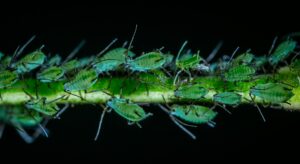 | Aphids are small (1/16" to 1/8"), soft-bodied, sap-sucking insects. Depending on species, their color can vary from green to yellowish to rose-colored or black. Some species may appear powdery or woolly. Adults are winged, but usually most of the infestation consists of wingless individuals. |
Bagworms (nuisance)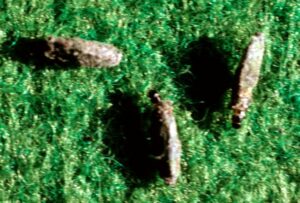 | Bagworms belong to a moth family called Psychidae. Their larvae live inside of peculiar cases or bags which they make from various plant materials or sand. |
Bed bugs (stinging & biting)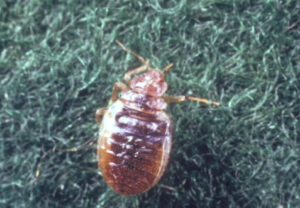 | Bed bugs are ectoparasites, which means that they feed on the outside of their host. They attack humans, bats, chickens, and occasionally other animals. Adult bed bugs are flat and small (around 1/4 inch long). |
Bird mites (stinging & biting)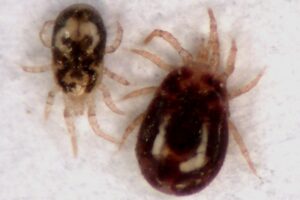 | Northern fowl mites and chicken mites are blood-sucking parasites of domestic poultry and wild birds throughout much of the United States. Both species can become a pest in the home when starlings, pigeons, sparrows, or other wild birds nest in the eaves, attic, chimney, etc. |
Bot flies [warbles] (stinging & biting)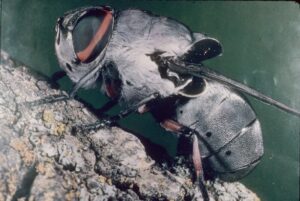 | Bot flies are among the few true insect parasites (a parasite is an organism that lives in another (the host) without killing it). There are two families: The robust bot flies (Cuterebrids) which include the tropical human bot fly and the rodent bot fly, and the warbles and bots (Oestrids) which include the northern cattle grub, sheep bots, horse bots and several others. |
Brown marmorated stink bug (nuisance)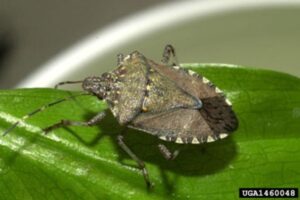 | The brown marmorated stink bug (BMSB) is an introduced species that is very mobile and spreading quickly across the United States. Both nymphs and adults are voracious feeders on a wide variety of plants, including small fruits, tree fruits, vegetables, and ornamentals. |
Bumble bees (curiosity & beneficial)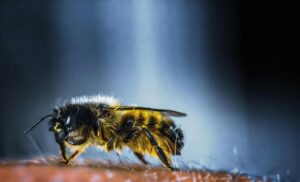 | Bumble bees are large, robust, hairy bees. They are early-season, social bees. Several species are native to the Pacific Northwest. While most are variously marked with black and yellow, some have distinctive orange or even reddish patches or stripes. |