Whiteshouldered house moth
categories: Fact Sheet Food and Fabric Pests
revision date: 2026-01-23 03:09
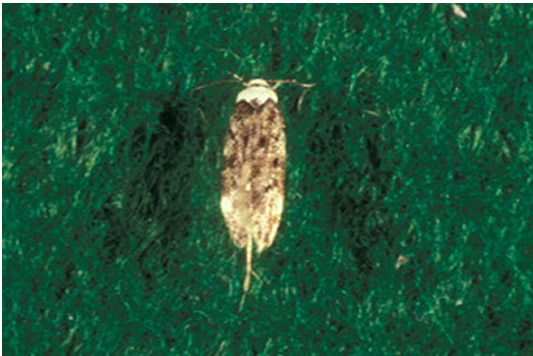
Photo by: Art Antonelli
Biology
The whiteshouldered house moth is occasionally found in household products. The adults are quite distinctive, having grayish-white wings with dark spots and a “shoulder” area that is bright white. This white shoulder becomes less pronounced as the adult ages.
Adults have a wingspan of about 1/2 to 3/4 inch. Larvae are white with brown heads and are about 1/3 inch long at maturity. Larvae feed on grain products, wool or other protein-based clothing or carpets, corks, dry seeds, fungi on trees, on rubbish in bird nests, and on other foodstuffs or organic debris which has accumulated.
Management Options
Use Integrated Pest Management (IPM) for successful pest management.
Non-chemical Management
Select non-chemical management options as your first choice!
- Find the source of the infestation and dispose of it.
- Physically destroy the larvae and pupae before they become reproductive adults. Adults can be eliminated with devices like fly swatters.
- Maintain food in tightly sealed containers to keep pests out.
Chemical Management
IMPORTANT: Visit Home and Garden Fact Sheets for more information on using pesticides.
- Pesticide applications are not an effective way to solve the problem.
- Sanitation or location and elimination of the source of infestation are the only long-term controls.
- If pesticide applications must be made, contact a pest management professional.

WSU Extension programs and employment are available to all without discrimination.
Evidence of noncompliance may be reported through your local Extension office.
Right click here and select Copy Link to copy fact sheet URL