Root weevils
categories: Fact Sheet Nuisance Pests
revision date: 2025-03-15 08:37
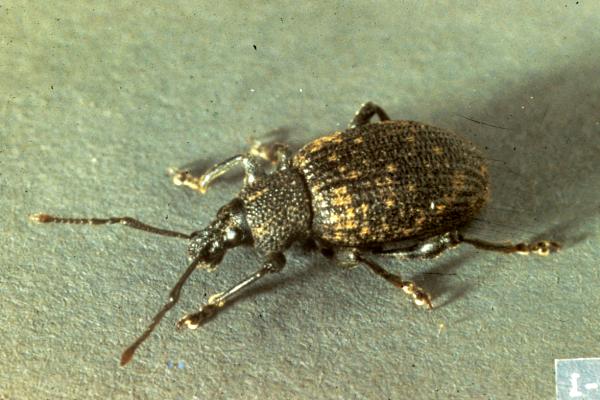
Photo by: Ken Gray
Biology
Several species of weevils commonly enter homes either singly or in small groups, usually during late summer and into the fall. These beetles are collectively called “root weevils.”
Outdoors, root weevils typically feed on plants including ornamentals such as rhododendrons, where they cause a distinctive notching on leaf margins. They can become a nuisance when they enter a home in large numbers. These weevils do not cause damage to the home, its contents or inhabitants, but may occasionally attack some houseplants.
Species commonly found in homes in the Pacific Northwest are typically brown to black in color and range in size from around 1/4 inch to just under 1/3 inch. Many species of weevils are characterized by a domed back and a “snout” on the front of the head. Most are unable to fly.
Root weevil infestations are temporary and harmless.
Management Options
See "Using Integrated Pest Management (IPM) in the Landscape" for successful pest management techniques.
Non-chemical Management
Select non-chemical management options as your first choice!
- For small numbers, vacuum or sweep up and remove insects.
- Make sure vents, windows, and doors are adequately screened. Repair or replace damaged screens and door sweeps to prevent access to wandering insects. Seal openings around baseboards, windows, doors, pipes, and wires entering the home.
- Remove sources of water and reduce irrigation near the house, as these can be attractive to insects.
- Do not plant shrubs, flowers, etc., near or against the foundation of the home to avoid attracting weevils and other pests.
Chemical Management
IMPORTANT: For more information on using pesticides, visit Home and Garden Fact Sheets | Pesticide Resources and Education Program | Washington State University.
- Use of pesticides to control root weevils inside the home is not recommended.

WSU Extension programs and employment are available to all without discrimination.
Evidence of noncompliance may be reported through your local Extension office.